
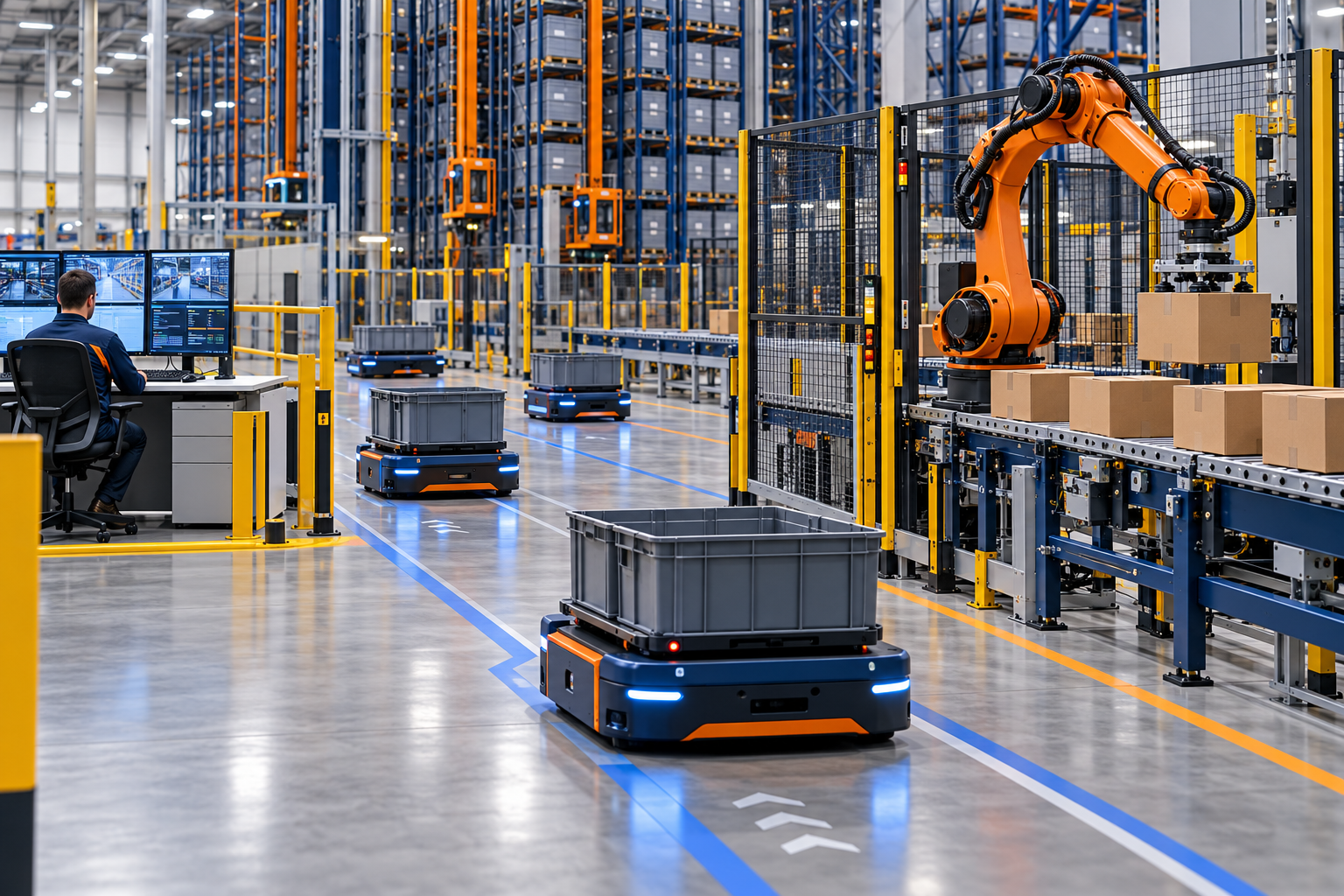
Choose the work before choosing the machine
An automotive operation may want to protect the flow of the correct parts to assembly. An e-commerce operation may want to make received stock available and complete varied customer orders before dispatch cut-offs. These illustrative priorities lead to different tests of automation, even when both use conveyors or mobile robots.
A convincing demonstration establishes that a task can be performed. The investment case also needs to show that the proposed change improves the relevant flow under representative demand, exceptions and operating costs.
Two primary accounts, with different evidence limits
Toyota describes its production system through Just-in-Time and jidoka: coordinating flow with demand, and detecting abnormalities so work can stop rather than pass problems downstream. Its explanation also places process improvement and understanding the work before mechanisation. This is a company account of operating principles, not a measured comparison between automotive and retail automation. [1]
Amazon’s October 2023 Sequoia announcement described an operating deployment in Houston combining mobile robots, gantries, robotic arms and employee workstations. It reported up to 75% faster inventory identification and storage, and up to 25% less time to process an order through a fulfilment centre. These are company claims about particular processes, not independently audited savings or guaranteed end-to-end delivery improvements. The same announcement described Digit as a test, which should not be treated as an equivalent operating deployment. [2]
The accounts support examining process design and system interaction. They do not establish which equipment another company should buy, a universal payback period or a causal return transferable between sectors.
Compare what the flow needs
This table is SCP’s proposed assessment lens, not a claim that every automotive or e-commerce site operates this way.
| Assessment lens | Automotive flow example | E-commerce flow example |
|---|---|---|
| Useful outcome | Required parts reach the right production step in time | Usable stock and accurate orders reach dispatch in time |
| Variation to test | Product mix, sequence changes, shortages and quality holds | Order mix, item dimensions, cut-offs, promotions and returns |
| Failure response | Protect the next process and resolve the abnormality | Protect stock accuracy and route incomplete or failed work |
| Value measures | Schedule adherence, quality, waiting and full operating cost | Order cycle time, accuracy, service and cost per comparable order |
Find the constraint that moves the outcome
For an automotive material flow, a local handling improvement may have little value if shortages or quality decisions still stop the next process. For an e-commerce flow, faster picking may simply move the queue to packing or carrier handover. These are hypotheses to investigate in the client’s records, not reported findings from the two sources.
Map arrivals, queues, processing, handovers and exceptions across the selected boundary. Test product and order mix, peak periods and recovery after downtime. Assess people, layout, replenishment, maintenance and information accuracy alongside equipment capability.
The design should also make authority clear: who may stop work, change priorities, route an exception or restart after a fault? Safety and engineering acceptance require the appropriate specialists. The pilot should preserve the approved controls while testing the operating case.
Build a business case that survives normal variation
Agree the baseline and eligible workload before the trial. The following are proposed measurement disciplines, not benefits already delivered by SCP.
- Compare throughput, service and quality at similar volume and mix, including peak and recovery periods.
- Include installation, integration, training, maintenance, support and any new handling or inventory costs.
- Treat released labour time as capacity until an expenditure change establishes a cash saving.
- Separate one-off working-capital movements, recurring savings and modelled disruption avoidance.
- Record adoption, equipment availability and fallback performance before recommending scale-up.
A bounded first step
An Automation Readiness Discovery Workshop can select one process, establish the constraint and identify the information needed to compare options. Inventory policy may need attention first if availability or replenishment drives the problem. The outcome would be a proposed assessment or pilot scope with acceptance measures, not an equipment commitment.
Sources and evidence notes
Sources checked on 17 October 2026. Research findings and company reports are attributed above; practical recommendations are SCP’s interpretation. The examples do not imply endorsement, partnership or SCP client results.
- Toyota Motor Corporation: Toyota Production System ↗
Undated company explanation; checked 17 October 2026. First-party description of operating principles; not an independent cross-industry performance study.
- Amazon: Sequoia and Digit robotics announcement ↗
18 October 2023. First-party deployment and performance claims; historical launch account, not independently audited by SCP.
Explore the industries and services
Explore the next step
Bring one process challenge, representative workload and queue information, layout constraints and any supplier proposal. Invite operations, engineering, systems, finance and people or training representatives.
Explore an Inventory and Service Discovery Workshop →
Workshop format and any fees are agreed before booking. Follow-on work requires a separate scope and business agreement.